

Creating an AGC for handheld microphones
Creating an AGC for handheld microphones
Automated sound reinforcement systems can provide excellent performance for speaking events without a sound operator present. Automatic mixers select which microphone is being addressed and mute the others. AGC (Automatic Gain Control) and compressors can adjust the volume down or up as needed to deliver the optimum sound level in the room.
The Problem
One problem that often springs up is with handheld and stand mounted directional microphones. These microphones usually have a significant amount of proximity effect, a bass boost when the microphone is very close to the mouth. It becomes difficult to properly balance these microphones with the rest of the system. The spectral balance changes with working distance. If you EQ it to sound natural at a distance of say 12” (30 cm), when a user moves closer to the microphone, it not only gets louder, it becomes more bassy. If you balance it for a close distance then the sound becomes very thin at a greater working distance.

This is exacerbated by an AGC or compressor trying to maintain a constant speech level. When the mic is held close, the AGC, which is looking at the electrical level without regard for frequency spectrum, lowers the level based on the excess bass content, and makes the middle and high frequencies, -the real speech content- even lower than they should be. Anytime someone leans in on a directional mic, the perceived level actually gets lower, since our level perception is based on mid and high frequencies.
The Solution
The solution is to create a two-band AGC which processes the low frequencies separately from the middle and high frequencies. The signal chain starts with a first order Butterworth crossover at around 500 Hz. A first order crossover, with it’s 6 dB per octave slope can have its bands recombined without phase anomalies. The low and high frequency outputs are sent through separate processing chains, then re-combined in a mixer.


Downloadable processing library
For more information about processing libraries read our tech note.
Why the Compressors?
This multiband processing could be done using the AGC blocks without compressors, but adding them does have an added benefit.The AGC does gradual gain adjustments both up and down towards the target level. The Compressor does fast level adjustments, downward only, to keep control of signal peaks. They can provide quick gain reduction until the slower AGC can reduce the level enough, eliminating the need for unnaturally fast AGC adjustment rates.
The Settings
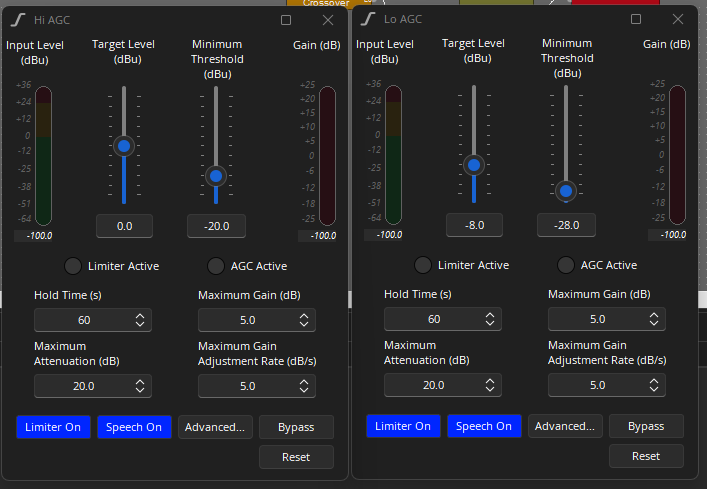
The Actual threshold and target level settings will be very dependent on the system gain structure, and the amount of headroom built into the design. If the system is designed so that 0 dBu is a good target voice level, then the default AGC settings will work for the high frequency AGC. For the low frequency AGC, start with the target level and minimum threshold about 8 dB lower than the HF, and adjust as needed.
Depending on the compression ratio and knee, the compressor threshold will be the same level or a few dB higher than than it's corresponding AGC target level. Keep all the makeup gains and mixer levels at unity as these would become a form of EQ and it’s better to EQ intentionally elsewhere. Keep all other settings the same between the LF and HF channels, so that they track properly.

Listen Up
Listen to the hand held mic, held closely and held distantly, speaking loudly and quietly. All cases should have a similar level and similar frequency balance when this cluster is properly adjusted. Using the distant case as the reference, adjust the AGC target levels and compressor thresholds for similar frequency balance when the mic is held closely.